
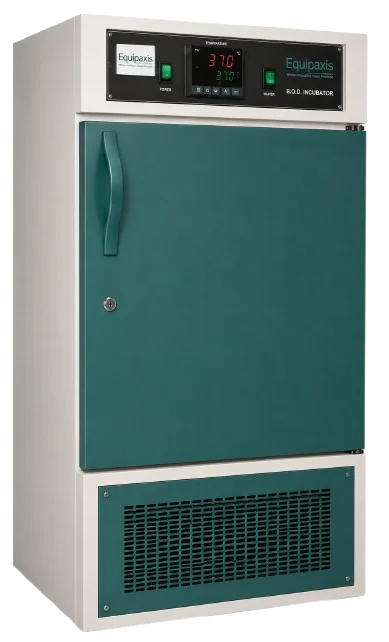
What Is a BOD Incubator? Principle, Working, Parts & Uses
BOD Incubator is nothing more than an apparatus specially designed to keep water and wastewater samples at a particular and consistently monitored temperature for days during which it measures the amount of oxygen utilized by microorganisms in the process of decomposition of organic substances. BOD Incubator resembles a general incubator used in laboratories in terms of its appearance but the only purpose it serves is providing consistent conditions for BOD testing. You can come across BOD incubators in environmental testing labs, water and wastewater treatment facilities, research institutions, quality-control departments, and university laboratories – every place where BOD is used to measure organic pollution or quality of water. To students, this piece of equipment is a common thing in environmental science and microbiology. For laboratory practitioners, it is a piece of infrastructure which determines how accurate test results will be. It is therefore important to understand how it operates, what it consists of, and how it is used.
What Is a BOD Incubator?
An autoclave is one of the most common pieces of equipment used in laboratories, hospitals and pharmaceutical facilities. Learning what is an autoclave is fundamental for any student or professional working in a sterile environment. Sterilization is the complete killing of all forms of microbial life including bacteria, viruses, fungi and tough bacterial spores . Autoclave machines use steam under pressure in a controlled way to achieve sterilization.
An autoclave is used to sterilize instruments, glassware, culture media, and other materials that can withstand high temperatures with pressurized steam to a level of microbial destruction that cannot be reliably achieved with boiling water or dry heat alone. This makes it an important piece of equipment in laboratories, hospitals, pharmaceutical manufacturing units and dental clinics where a fast, reliable and reproducimethod of eliminating contamination risk is essential.
Principle of a BOD Incubator
A BOD incubator operates in pursuit of one goal: stable temperature incubation —providing stable conditions for biological processes (i.e., microbially driven oxygen consumption) to take place.
Here is what this means in practice:
● Stable environment. The chamber is insulated and sealed in a way that allows it to maintain a constant temperature despite slight variations in the ambient room temperature during the time that incubation takes place — usually several days.
● Importance of temperature for incubation: Microbial metabolites are dependent on temperature, meaning that if temperature changes during incubation, the biological process will also change, and the readings on the BOD meter will be of no use for reliable comparisons of the samples.
● Temperature controllers compare the temperature inside the chamber to the set temperature and make adjustments in terms of heating and/or cooling accordingly.
● PID microprocessor controllers are used in BOD incubators for controlling temperatures. Instead of merely switching the heating element on or off, a PID controller finds out how far the current temperature is from the set value and how quickly it is changing and provides for adjustment of the heating in proportion to these parameters. This ensures that the temperature remains smoother and
more steady than with the on/off controller with no overshoots.
● The significance of temperature homogeneity: Maintaining the average temperature is important, but it is equally important that the temperature is uniform throughout the chamber. If one shelf in the chamber is warmer than the others, the samples placed on different shelves would be tested under different experimental conditions.
● Air Circulation’s Role in Temperature Regulation: The air circulation system employs a fan to maintain air circulation in the chamber to provide even heat distribution, preventing heat from accumulating in one area next to the heater. This changes the average temperature to average temperature across the whole space.
Construction & Parts of a BOD Incubator
A BOD incubator is built as a well-insulated chamber wrapped in supporting systems for temperature control, air movement, and monitoring. The table below summarizes the main parts and what each one does:
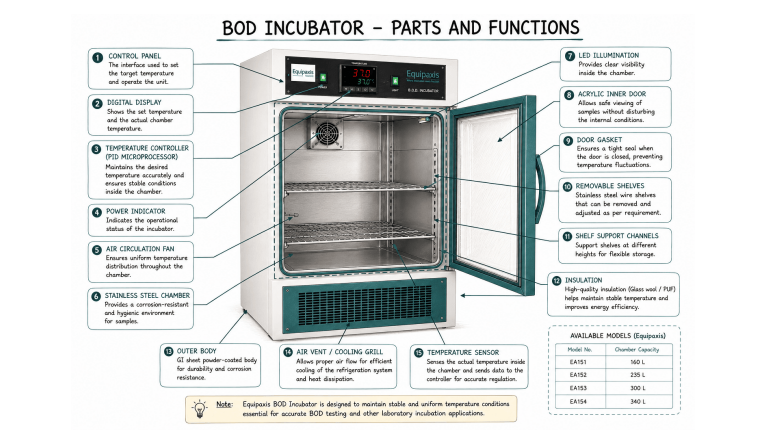
A BOD incubator is built as a well-insulated chamber wrapped in supporting systems for temperature control, air movement, and monitoring. The table below summarizes the main parts and what each one does:
| Part | Function |
|---|---|
| Outer body | The external structure that houses and protects the internal chamber and components – typically a sturdy metal casing, often powder-coated for corrosion resistance and a durable finish. |
| Inner chamber | The enclosed space where samples are placed and incubated. Usually made of a smooth, corrosion-resistant material that is easy to clean, since it comes into direct contact with the incubation environment. |
| Insulation | A layer between the outer body and inner chamber that minimizes heat exchange with the surrounding room, supporting stable temperature and energy efficiency. |
| Inner door | Often transparent, allowing samples to be checked visually without opening the chamber and disturbing the internal temperature. |
| Shelves | Used to organize and position multiple samples inside the chamber; removable shelving allows flexible loading and easy cleaning. |
| Temperature controller | Regulates and maintains the chamber at the set target temperature (commonly a PID microprocessor controller). |
| Temperature sensor | Continuously measures the actual chamber temperature and feeds this data to the controller. |
| Air circulating fan | Distributes air throughout the chamber to maintain uniform temperature across all shelves. |
| Heating system | Supplies the controlled heat needed to reach and hold the set incubation temperature. |
| Digital display | Shows the current and set temperature, allowing users to monitor conditions at a glance. |
| Control panel | The interface used to set the target temperature and operate the unit. |
How Does a BOD Incubator Work?
The working process of a BOD incubator can be broken down into a simple sequence:
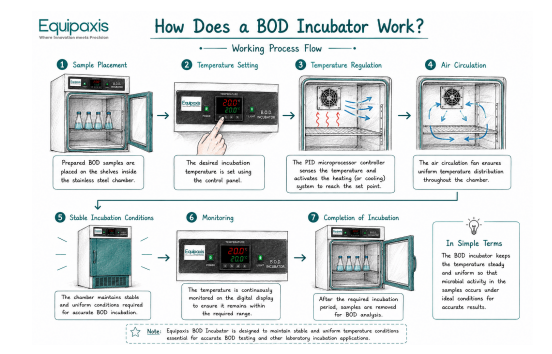
Sample Placement → Temperature Setting → Temperature Regulation → Air
Circulation → Stable Incubation Conditions → Monitoring → Completion of Incubation
The process involved in the use of an incubator consists of several key stages:
1. Placement of samples on the incubator shelves: The samples must be placed on the shelves of the incubator chamber in accordance with the existing procedures that the laboratory follows.
2. Temperature adjustment: The next step is to set the needful incubation temperature on the control panel. To select the temperature, one should consider the method of test one is going to perform.
3. Temperature control. The temperature controller is able to compare the temperature inside the chamber to the target one and adjust the heating system accordingly.
4. Circulation of air: The air circulating fan makes sure that the air circulates through the chamber evenly, thereby making the temperature uniform at all levels, not allowing it to be concentrated at the upper part of the chamber.
5. Maintaining incubation conditions: The incubator provides constant conditions under any circumstances throughout the incubation time.
6. Observation: The display of the incubator indicates the temperature and helps to check its values without interruption of the sampling.
7. Completion of incubation: After the end of the incubation time, the samples are taken out of the incubator chamber, being ready for measurements and further studies
Uses and Applications of a BOD Incubator
● Environmental Laboratories
Environmental testing laboratories make use of BOD incubators in their work, wherein this equipment is utilized for determining organic pollution in water bodies as well as in effluents and effluent samples. Alkalinity is an indicator of the organic loads that can be decomposed by natural process in water bodies.
● Water and Wastewater Testing
BOD is widely used as one of the indicators for water and wastewater quality testing, whereby monitoring of BOD requires stable conditions. Furthermore, the period and the level of adaptation needs to be the same during testing process.
● Microbiology Laboratories
Microbiology laboratories conduct environmental measurements that require specific conditions for conducting different incubation-based operations. The constant temperature control provided by the BOD incubator makes this equipment appropriate for laboratory operations where temperature conditions need to be the same.
● Research Laboratories
The BOD incubator is widely used in laboratories for research purposes to provide proper condition for their experimental setups
● Quality Control Laboratories
In quality-control laboratory the BOD incubator is a tool for continuous tests performed regularly in laboratories to make sure they fulfill required standards for testing.
● Educational and Academic Laboratories
BOD incubators are also standard apparatus in the laboratories of different colleges and universities offering science-related majors, where students learn about the principles of BOD testing and the operation of incubators.
Advantages of a BOD Incubator
The incubator provides controlled incubation condition which enables consistent and comparable results from samples and runs.
● Temperature stability is much better than in uncontrolled or less controlled environments.
● The incubator can handle long incubation duration as stable conditions are preserved during this time.
● A BOD incubator can control the samples very efficiently with the help of digital displays and clear doors.
● The environment inside the incubator is very homogenous; thus the samples placed at different levels of the incubator do not give different results.
● The incubators can be widely used in laboratories doing environmental and water
testing, microbiological, and research activities.
What is a BOD Incubator?
A BOD incubator is a temperature-controlled chamber used to incubate water or wastewater samples under stable conditions for Biochemical Oxygen Demand (BOD) analysis.
What is the full form of BOD Incubator?
BOD Incubator stands for Biochemical Oxygen Demand Incubator.
What is the principle of a BOD Incubator?
It works on the principle of controlled temperature regulation and uniform air circulation, maintaining a stable environment so microbial oxygen consumption can be measured consistently.
How does a BOD Incubator work?
A temperature controller (commonly PID-based) regulates the heating system to hold a set temperature, while a fan circulates air to keep conditions uniform throughout the chamber for the duration of incubation.
What is a BOD Incubator used for?
It is used to incubate samples for BOD testing, a key indicator of organic pollution used in environmental, water/wastewater, research, and quality-control laboratories
What are the main parts of a BOD Incubator?
Key parts include the inner chamber, outer body, temperature controller, temperature sensor, air circulating fan, shelves, inner door, insulation, and digital display.
What is the use of a BOD Incubator in a laboratory?
It provides the stable, controlled temperature environment required for BOD sample incubation, supporting consistent and comparable water-quality testing results.