
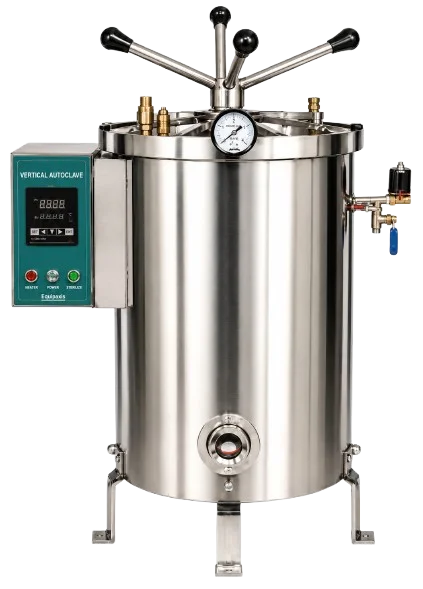
HOW TO CHOOSE AN AUTOCLAVE FOR YOUR LAB?
The purchase of an autoclave is not just buying any other piece of equipment. Rather, the selection process should be thought through, since it is an important tool which guarantees safety, sterility, and efficiency of the workflow within the laboratory
ESTABLISHING STERILIZATION NEEDS
The first thing to think about is what exactly needs to be sterilized in the laboratory ie is it culture media, liquids, glassware, surgical instruments, or biohazardous waste. Each of these types of material requires a different set of parameters for effective sterilization. Liquid loading requires a slower vent cycle, since it prevents bottles from over-boiling. Wrapped instruments need to have enough time to dry after sterilization in order to remain sterile. Waste decontamination cycles in microbiology and clinical laboratories usually require a longer exposure time. Identifying the requirement allows finding a laboratory autoclave which meets the actual laboratory needs.
CHAMBER SIZE AND CAPACITY
The capacity of the autoclave should be chosen based on realistic projections of the number of items which need to be sterilized in the laboratory. While a small bench-top model might be sufficient for a teaching laboratory or a small research team, it would be inefficient for a pharmaceutical or industrial company, which works in batches. On the other hand, overinvesting in a larger autoclave, which is not used regularly, means wasting money and resources.
Laboratories are recommended to project their needs based on peak load times.
TYPES OF AUTOCLAVES
There are basically three main types of autoclaves which differ in their design and efficiency.
There are gravity displacement autoclaves, which are quite simple and cost-effective, but not very good at removing air. This fact leads to ineffective sterilization of dense or wrapped loads.
Pre-vacuum (high-vacuum) autoclaves are more efficient at removing air, which makes them preferable in case of porous or wrapped loads.
The choice between floor-standing and bench-top autoclaves is mostly made based on laboratory space considerations.
SAFETY FEATURES
Since autoclaves work under high pressure and high temperatures, safety features should be considered a requirement and not a supplementary function.
Among these features one may mention door interlock, which prevents the door from opening while the chamber is under pressure, over-temperature/over-pressure control and pressure relief valves. When it comes to laboratories which deal with biohazardous materials, a feature of documented cycle should be taken into account due to the need for regulation compliance.
EASE OF USE AND AUTOMATION
Programmable cycles is a common feature among modern autoclaves. It helps to avoid mistakes made by laboratory workers when using the equipment.
MAINTENANCE AND SERVICE SUPPORT
The equipment is always an investment, so it is important to choose an autoclave which provides good support and has available spare parts. Regular gasket inspection, calibration and water quality check are required in order to sustain safety and efficiency of the autoclave operation.
WHY EQUIPAXIS IS THE IDEAL CHOICE FOR YOU?
Speaking about the choice of the autoclave which will provide safety, efficiency, and reliable after-sales support, one can refer to Equipaxis, which is one of the best autoclave manufacturer and provider for research, biotech, healthcare and pharmaceutical laboratories. Being a reliable manufacturer of the laboratory equipment for universities and research centers of India, Equipaxis provides an autoclave which is able to perform routine sterilization of glassware and decontamination of the biohazardous waste.
What makes an autoclave from Equipaxis special is a reliable build quality, professional consultation, and reliable after-sales support – all these factors were mentioned above as key when choosing an autoclave. Instead of dealing with several vendors for purchasing equipment and servicing it, laboratories have a chance to have one trusted partner for autoclave, biosafety cabinet, incubator, cryogenic system and any other equipment.
If a laboratory needs a sterilization solution which can be used now and meet their further requirements, an Equipaxis autoclave is the best choice. In case a laboratory is going to make a purchase of an autoclave, one may contact Equipaxis for consultation and recommendation.
CONCLUSION
The process of choosing a laboratory autoclave requires comprehensive planning. It includes understanding of sterilization needs, capacity requirements, safety standards, and serviceability. Being a reputable company providing good equipment and reliable service support, Equipaxis becomes an ideal choice for laboratories which need reliable sterilization solutions. The choice of an autoclave from Equipaxis provides a laboratory with the reliable sterilization solution, improved laboratory safety and efficient workflow.