
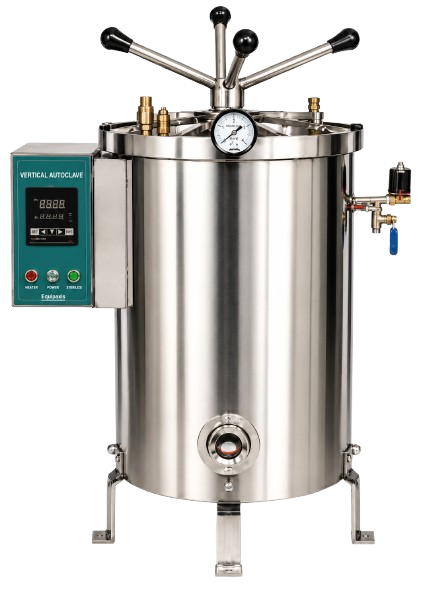
An autoclave is one of the most common pieces of equipment used in laboratories, hospitals and pharmaceutical facilities. Learning what is an autoclave is fundamental for any student or professional working in a sterile environment. Sterilization is the complete killing of all forms of microbial life including bacteria, viruses, fungi and tough bacterial spores . Autoclave machines use steam under pressure in a controlled way to achieve sterilization.
An autoclave is used to sterilize instruments, glassware, culture media, and other materials that can withstand high temperatures with pressurized steam to a level of microbial destruction that cannot be reliably achieved with boiling water or dry heat alone. This makes it an important piece of equipment in laboratories, hospitals, pharmaceutical manufacturing units and dental clinics where a fast, reliable and reproducimethod of eliminating contamination risk is essential.
What Is an Autoclave?
An autoclave is a sealed device, pressure rated, using saturated steam under pressure to sterilize equipment and materials. The autoclave machine works by exposing items to steam at a temperature above the normal boiling point of water for a period of time. This is sufficient to kill even the heat resistant microbial spores.
Autoclave is a machine used for sterilization . Sterilization is not the same as cleaning or disinfecting . Cleaning takes away visible dirt and disinfection kills microbes, but sterilization is a complete kill step. After a validated autoclave cycle, an item is considered to be free of all viable microorganisms, including bacterial endospores, which are particularly resistant to other methods of destruction.
Autoclaves are used in a variety of settings, such as:
- Laboratories – for sterilizing glassware, culture media and reusable labware
- Hospitals and clinics – reprocessing of surgical and reusable medical instruments
- Pharmaceutical manufacturing – For suitable steam-sterilizable equipment and materials
- Dental Practices – Sterilizer for Dental Hand Tools
- Research institutions—decontamination of biological waste before disposal
Principle of Autoclave
The autoclave works on the principle of moist heat sterilization. Moist heat (saturated steam) is far more effective in transferring thermal energy than dry heat, because when steam condenses on a cooler surface such as an instrument or piece of glassware, it liberates latent heat. In this condensation process , microbial proteins and enzymes are rapidly denatured , destroying the organism .
Several scientific principles underpin this process:
- Pressure raises the boiling point of water. At atmospheric pressure water boils at 100°C, which is not hot enough to kill bacterial spores in a reasonable amount of time. By sealing the chamber and increasing pressure an autoclave allows steam to reach much higher temperatures, often, around 121°C without losing the power of the steam to sterilize things.
- Saturated steam is essential to the process. Saturated steam means steam that’s in balance with liquid water at a set pressure. Saturated steam carries heat per unit, than dry heat or superheated steam at the same temperature. This is because when steam condenses it releases heat.
- Temperature and pressure are tied together. In steam sterilization a certain pressure always matches a saturated steam temperature. That is why autoclave cycles always list both a temperature and a pressure. They are not separate; they are linked by the rules of steam physics.
- Exposure time is just as important as temperature. Getting to the temperature by itself is not enough. The material needs to stay at that temperature for a tested amount of time to make sure all the germs are destroyed, even in thick items or liquids that take longer to heat all the way through.
- Heat moves through steam contact. Steam has to touch every part of the material that is being sterilized. Proper placement making sure all the air is gone and not having things packed tight or trapped in a way that stops the steam from getting in are all very important, for a good cycle.
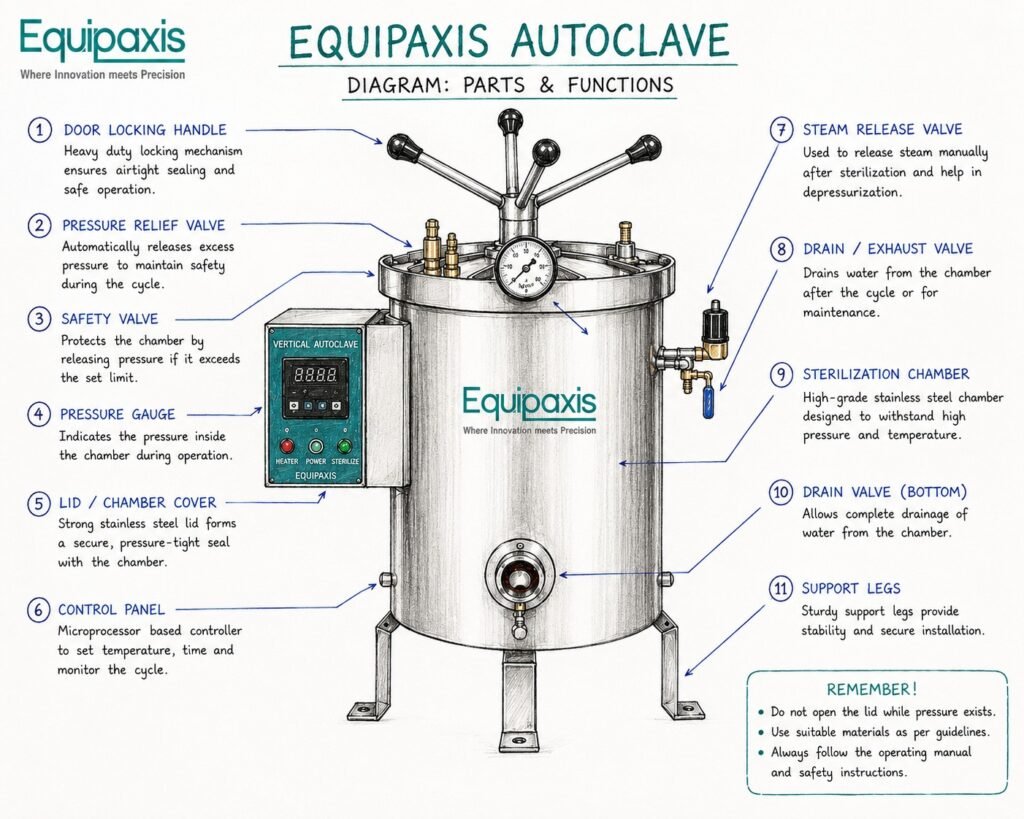
AUTOCLAVE - PARTS AND FUNCTIONS
Understanding each part of an autoclave clearly is essential to understand how the whole autoclave system works.
The table, below lists the components that are found in most autoclave designs.
| Part | Function |
|---|---|
| Sterilization chamber | The enclosed space in which items are placed and exposed to pressurized steam during the cycle. |
| Door / lid | Seals the chamber, allowing pressure and temperature to build safely inside. |
| Door locking mechanism | Secures the door during the cycle and typically prevents it from opening until internal pressure has been safely reduced. |
| Pressure gauge | Displays the current chamber pressure, allowing the operator to monitor the cycle. |
| Safety valve | Automatically releases excess pressure if it exceeds the safe operating limit, preventing damage or hazardous over-pressurization. |
| Steam generator / heating element | Produces the steam used for sterilization, either from an internal water reservoir or an external steam supply. |
| Temperature sensor | Monitors chamber temperature throughout the cycle to maintain the required sterilization conditions. |
| Control panel | Enables the operator to select, initiate, monitor, and adjust sterilization cycles and parameters. |
| Drain | Removes condensate and waste liquid from the chamber during and after the cycle. |
| Pressure-release system | Safely depressurizes the chamber at the conclusion of the cycle before the door can be opened. |
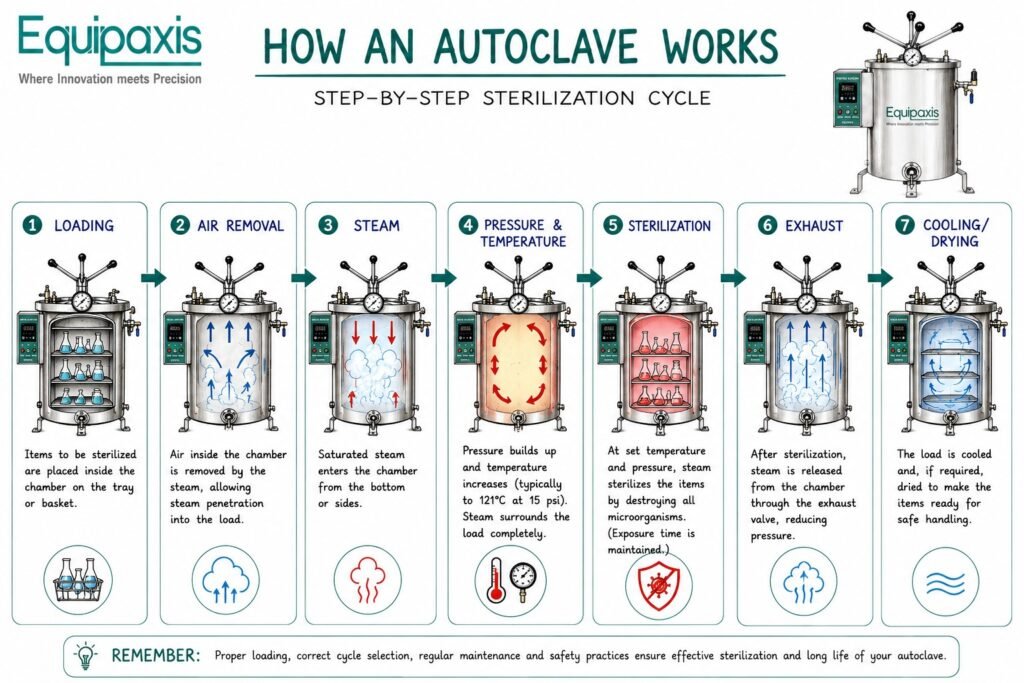
HOW DOES AN AUTOCLAVE WORK?
Loading: Articles are placed in the chamber in such a way that allows steam to be in contact with all surfaces. Overloading or improper placement of items may reduce the effectiveness of sterilization process.
Air Removal: Air present in the chamber is removed by gravity displacement or by vacuum pump in case of a particular type of autoclave since pockets of air will prevent steam from reaching all surfaces.
Steam generation or introduction: Steam is introduced into the chamber either generated inside the chamber itself or provided externally.
Pressurization: As the steam builds up in the sealed chamber, the pressure increases resulting in increase in temperature to above its boiling point under normal atmospheric conditions.
Sterilization or exposure: The chamber is kept at required temperature and pressure for predetermined time to enable steam to kill microorganisms on the articles.
Exhaust/Depressurization: After exposure of articles to steam, exhaust steam is released to de-pressurize the chamber.
Cooling/Drying: Articles may need to be cooled and dried based on their type
AUTOCLAVE TEMPERATURE — WHY 121°C?
121°C is the temperature that is commonly utilized to carry out steam sterilization using an autoclave. Saturated steam, at this temperature, helps in killing many microorganisms through the process of sterilization if the desired period is attained.
Temperature + Pressure + Time = Sterilization.
High temperature sterilization cycles such as 134°C may also be used, depending on the autoclave, load, and validated sterilization process.
Key Concept: 121°C is a common sterilization temperature, but the right cycle varies according to equipment, load, and validated process.
TYPES OF AUTOCLAVES
Different autoclave models exist that vary according to the setting they are used in and the kind of loads to be processed.
- Vertical autoclave – This is a smaller model that is usually top loading and is mainly used in smaller labs where there is restricted floor space.
- Horizontal autoclave – This is a larger autoclave that is front loading and is used in hospitals and industry to perform more extensive sterilization.
- Tabletop/benchtop autoclave – This autoclave is smaller and used for loads performed in lab benches or dental clinics.
- Gravity displacement autoclave – Uses gravity to displace the lighter air inside the chamber with heavier steam for sterilization.
- Vacuum or pre-vacuum autoclave – This autoclave uses vacuum pump to actively remove air before introducing steam for faster penetration, especially for wrapped loads.
USES OF AN AUTOCLAVE
Autoclaves are mainly applied to sterilize materials by steam that can withstand temperature, moisture, and pressure.
- Laboratories: Sterilization of appropriate glassware, culture media, laboratory devices, and some biological waste.
- Healthcare Sector: Sterilization of appropriate surgical and medical tools.
- Pharmaceutical Industries: Sterilization of appropriate tools and materials required in manufacturing.
- Dental Clinics: Sterilization of appropriate and heat-moisture resistant dental tools.
- Research & Biotechnology: Sterilization of laboratory tools and materials utilized for microbiological and biological research.
WHAT CAN BE STERILIZED IN AN AUTOCLAVE?
Autoclaving involves sterilizing materials which have the capacity to withstand high temperatures, moisture and steam under pressure. Suitability of material to be sterilized using an autoclave is determined by the composition of the material, packaging and the sterilization cycle.
Commonly Sterilized Materials
- Laboratory Materials
- Flasks
- Bottles
- Test tubes
- Beakers
- Culture media and aqueous solutions
- Autoclavable plastic ware
- Laboratory equipment
- Biologic waste
- Medical and Dental Materials
- Stainless steel surgical instruments
- Medical equipment and instruments
- Dental equipment
- Certain dressings and textiles
- Pharmaceutical and Research Applications
- Equipment and components
- Containers and utensils
- Microbiological, biotechnical and pharmaceutical process materials
Materials Usually Unsuitable for Autoclaving
Materials which are sensitive to heat, moisture or pressure should not usually be subjected to standard steam autoclaving. Such materials may include most oils, powders, heat-sensitive plastics and electronics among others.
It is important to ensure that the material is compatible with the sterilizer and follow the manufacturers’ instructions and the validated sterilization cycle.
BASIC AUTOCLAVE SAFETY
The operation of an autoclave involves a combination of heat and pressure, necessitating knowledge about some safety measures:
- It is not advisable to load too many things inside since the steam needs enough space to work on the material.
- It is important to ensure that the material used in the process is compatible with steam sterilization.
- Always avoid using poorly closed containers when loading liquid since there is a possibility of pressure build up which can result in breaking of the vessel.
- Proper PPE should always be worn when loading and removing materials from an autoclave.
- Avoid disabling any safety devices like the door lock and safety valve.
- It is never advisable to open the autoclave while still under pressure.
- Ensure proper cooling period after finishing the cycle.
FREQUENTLY ASKED QUESTIONS
What is an autoclave?
An autoclave is a device that uses pressurized steam to sterilize compatible instruments, glassware, and other materials by destroying microorganisms, including resistant spores.
What is the principle of an autoclave?
It operates on the principle of moist heat sterilization, in which saturated steam under pressure transfers heat efficiently, denaturing microbial proteins and destroying microorganisms.
How does an autoclave work?
It loads items, removes trapped air, introduces steam, builds pressure and temperature, holds the load at sterilizing conditions for a defined period, and then safely exhausts pressure prior to cooling and unloading.
Why is autoclave temperature 121°C?
At approximately 15 psi of pressure, saturated steam reaches roughly 121°C, a temperature validated to reliably destroy microorganisms within a practical exposure period for many standard loads.
What are the main parts of an autoclave?
Key components include the sterilization chamber, door with locking mechanism, pressure gauge, safety valve, steam generator, temperature sensor, control panel, drain, pressure-release system, gasket, and tray/rack system.
What is an autoclave used for?
It is used to sterilize compatible items in laboratories, hospitals, pharmaceutical manufacturing, and dental clinics.
What can be sterilized in an autoclave?
Many heat- and moisture-resistant materials are suitable, though suitability always depends on composition, container type, and manufacturer or institutional guidance.
What are the different types of autoclaves?
Common types include vertical, horizontal, tabletop/benchtop, gravity displacement, and pre-vacuum/vacuum autoclaves
What is the difference between an autoclave and a dry heat sterilizer?
An autoclave uses moist heat in the form of pressurized steam, whereas a dry heat sterilizer uses hot air without moisture. Autoclaves generally achieve sterilization more quickly and at lower temperatures, owing to the efficient heat transfer of steam.
Leave a Comment
Your email address will not be published. Required fields are marked